Sanitation
Purpose:
- Management of sanitation services for a company with a head office and subsidiaries in different cities.
- Integrated accounting
- Accounting balance on subsidiaries and balance consolidated on the head office.
Organization for the sanitation activity.
In the application the activity is organized based on the route.
A route is a list of places that need sanitation services.
The route is established so that we will obtain an optimum for sanitation car filling.
Subscribers mandatory fall in groups of clients. The application automatically generates a code for each subscriber(folio) so that each subscriber's code is unique. Search for a subscriber in the database is done after name, folio, address,and in the window with general data, after CUI/CNP.
Client groups can be as many as needed, for example CASE, Firm1 (companies that bill on the 1st of every month), Firm30 (companies that bill at the end of the month), etc. The user has the possibility to modify and add groups of clients anytime it is needed.
Each subscriber has one or more workstations.
Each workstation has a responsible person for that workstation; according to the way the company operates this can be a cashier or a foreman. .
By giving workstations a foreman, the production can be easily tracked according to the foremen. Billing is done according to routes.
Services refer to: m3 trash, m3 debris, number of people, Euro container, container 4m3, Trash can 120l, Trash can 240l, Large Container, etc
There can be defined as many services as needed - there are codes of products and services - with defined prices and catalog of prices.
In the contract that is made with each client these services are introduced.
Services can be divided in groups of services. For example Manager, Selective, Street, etc.
This division allows establishing routes based on services for example household waste and ecological one is collected with different cars.
If billing of different services is done separately, or can be done as objects of the same contract or different contracts, it can be done by filtering the services on these groups of services.
The price in the contract can be defined in lei or Euro.
For the contracts defined in Euro the cost of services is is calculated by applied at the end of the billing day.
Easy division on routes territory.(in the application they are called sectors); a route represents what a car can load during one transportation.
The possibility to move a street from one route to another to make sure the car is completely filled and thus make the process more efficient.You can see the volume in cubic meters of the route and how much it becomes if a street is moved or a client, in or from the route.
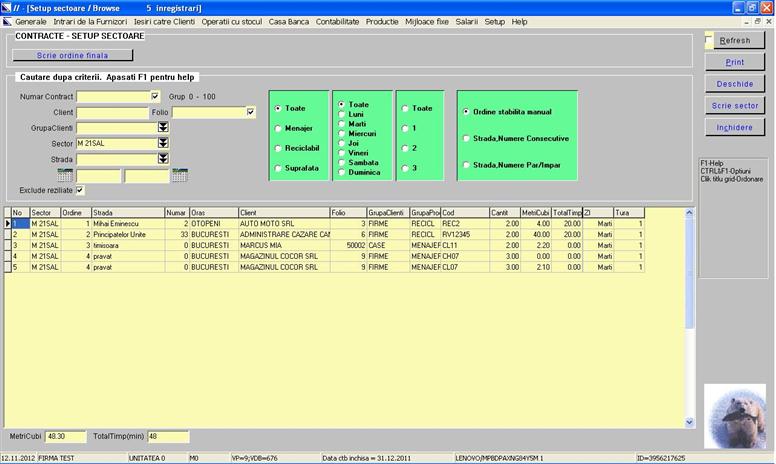
The possibility to change the way the route is followed, with a simple click. In a short time the territory is divided in routes that respect the loading capacity of the trucks.
Setting the route it is only done once, at the start of the application then, the module is accessed when the need to make a modification in the manner in which the routes are followed or new workstations appear.
Client Contract Module
The services that the contract provides are definied, the place in which they are provided, the days of the week in which they are provided and the shift;
The services contained in a contract can be billed at different workstations for a client .
It can be set from the begining the expiration date for the contract, after which the application will no longer generate bills for that contract.
There can be defined a period of suspension for a contract; the application will no longer bill services during that period. The period can be edited and with how much a certain quantity from the contract modifies; the application bills the modified quantity,and after the chosen period it automatically returns to its initial value.
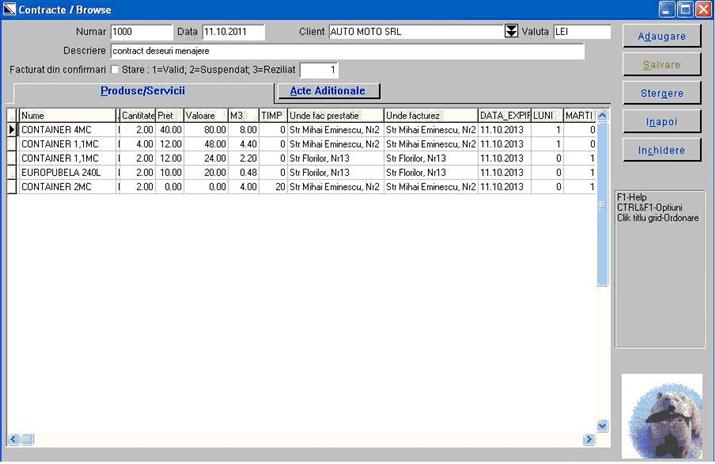
The contract can be :
- With fixed quantity –the user does not have to edit anything because it is considered that each month the registered quantities from the contract are billed.
- With billing from confirmation – when the loaded volume modifies and has to be edited for that particular month. For these types of contracts the application takes the quantities from the confirmation sheets, which are registered in the programe for each machinery.
Changing the type of contract for a certain client can be done very easily, by simply checking the correct type.
Contract can be filtered in a simple manner, by using a checking method.
Generate collection route Module (Roadmap)The roadmap leaves with the driver, so that he will know the order in which clients should be visited and the quantities that need to be collected (if they have been established in the contract) .
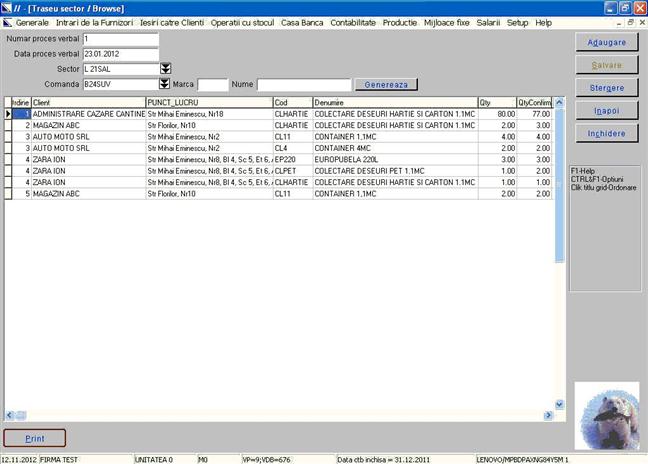
Introducing collection confirmation Module: for each route the client is edited, the collection point, the service conducted and the quantity received; if the service is definied in this manner in the contract for that certain client, the application automatically completes the minim quantity to be billed. The user edits the quantity picked up.
There is a module for introducing confirmation of unloading at the organic pit which contains the date, sector, truck, the type of waste that is being unloaded, weight in kg. It is so known the income brought by each truck every month.
Billing Contracts
For example, a group of clients is filtered from the contract, and the "generate bill" button is clicked.
The values of the billed services are taken from the contract according to the type of the contract: with fixed quantities or by confirmation.
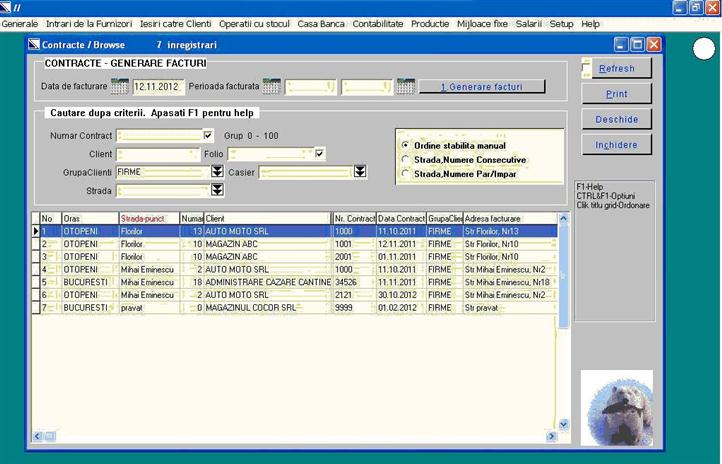
When generating, the time interval for which the bill is issued has to be selected; for example, if a bill is done in August, for August, September and October, the application will not generate another bill for the months September and October for that particular client.
Bills can be printed individually or in lots. There are different criteria and filters that can be set for printing for example group of clients, street, interval of time, date of billing.
Penalty Module
This module calculates the penalties for a group of clients or selected sector; the module is flexible and allows access to the administrator to set a percentage for penalties, the date from which the penalty should be applied, respecting the legislation.
The previously calculated penalty is taken from the client's bill when the bill of benefits is generated .
There is the possibility of removing the penalties calculation from a certain bill; at any moment the user can go back to this state.
All specific reports for administrating the sanitation services are generated: issued bills and influx for each type of subscribers, streets, cashiers, contracts from a certain date, additional papers for a certain date, balance of clients according to their type, confirmation centralization, sheet for penalty calculation etc.; contracts, notifications, summons can be printed.